AI as a Core Capability: Redefining Enterprise Operating Models
Why true competitive advantage comes from embedding intelligence directly into business operations, rather than deploying standalone point solutions
 3 min read
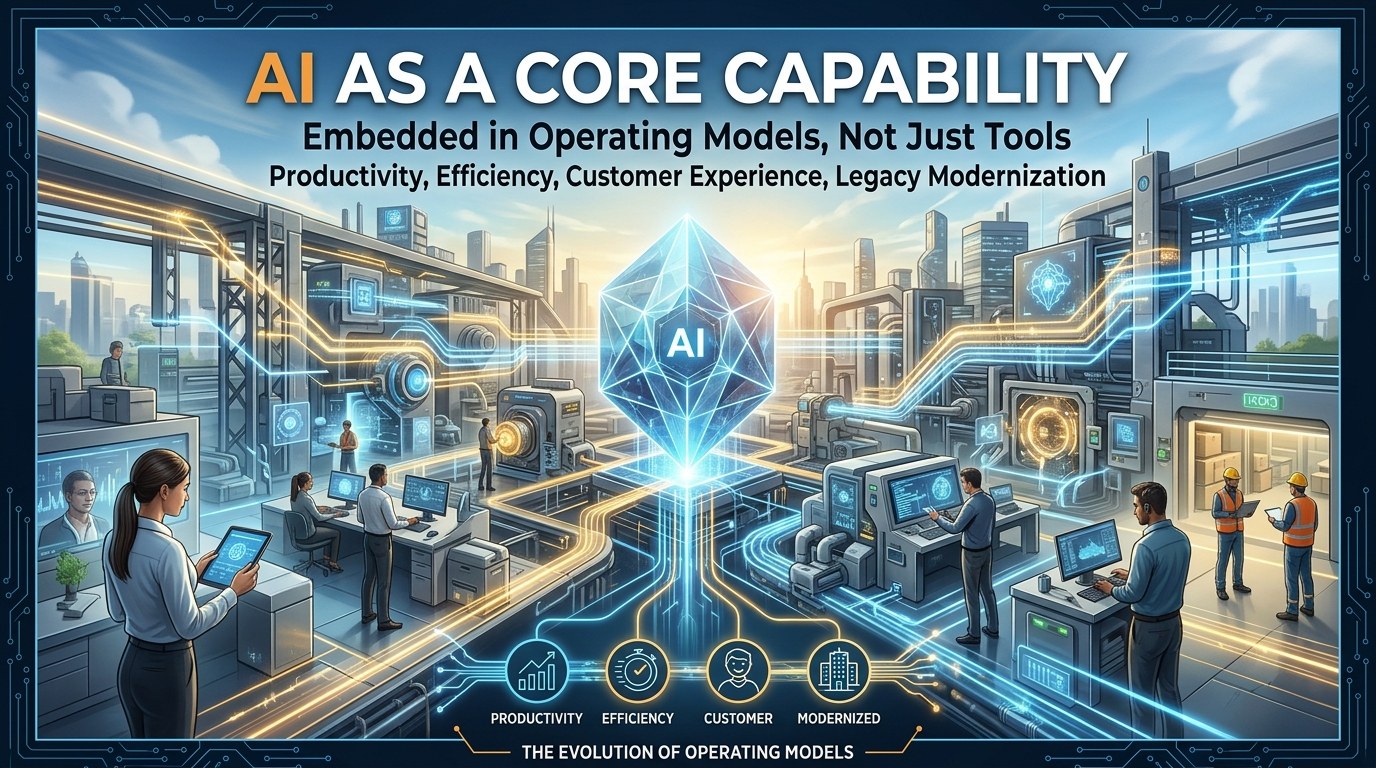
Executive Summary
The era of experimenting with artificial intelligence through isolated pilots and ad-hoc software tools is coming to a definitive close. Forward-thinking enterprises are recognizing that generative and predictive models yield negligible long-term value when treated merely as desktop utilities. To unlock transformative gains, intelligence must be woven directly into the structural fabric of the enterprise operating model.
When artificial intelligence is elevated from an IT application to a fundamental operating capability, organizational workflows adapt dynamically. Decisions that once required multi-tiered human review become automated or algorithmically augmented, while legacy processes shift from reactive execution to proactive orchestration.
The Three Strategic Pillars
Productivity & Operational Efficiency (Primary Engine / Immediate ROI)
Customer Experience (Key Differentiator / Market Growth)
Legacy Modernization (Enabling Pillar / Tech Debt Reduction)
1. The Primary Engine: Driving Productivity & Efficiency
While market rhetoric often emphasizes blue-sky innovation, real-world capital allocation reveals a clear priority: operational efficiency and productivity dominate the strategic agenda. Embedding AI directly into core business workflows allows organizations to eliminate structural friction and dramatically lower transaction costs.
Instead of simply speeding up individual tasks (e.g., writing emails faster), an embedded AI capability redesigns entire end-to-end processes. Accounts payable, underwriting, claims management, and supply chain routing are being re-engineered to operate with autonomous baselines, escalating only edge cases to human specialists.
The Tool vs. Capability Distinction
AI as a Tool: An employee copies data into a web-based chatbot to summarize a report, keeping underlying business processes unchanged.
AI as a Capability: The core ERP automatically ingests, analyzes, and acts on incoming data stream triggers, routing optimized decisions directly into execution channels.
2. Elevating the Customer Experience (CX)
Productivity savings provide the capital engine, but elevated customer experience creates market differentiation. Once operational friction is reduced, AI capabilities allow organizations to deliver hyper-personalized, contextualized customer journeys in real time.
Modern embedded customer experience models move beyond primitive conversational bots. By integrating deeply with real-time customer data platforms (CDPs) and core transactional engines, AI systems instantly understand user context, anticipate needs, and resolve complex interactions without multi-department handoffs.
3. Unlocking Legacy Modernization
The greatest barrier to operating model transformation is often technical debt. Decades-old core systems—monolithic databases, custom mainframe logic, and fragmented API layers—hold back agility. Treating AI as a core capability provides a triple benefit for legacy architecture:
Code Translation & Documentation: Automated intelligence systematically parses, documents, and refactors legacy COBOL, Java, or SQL codebases into modern cloud-native architectures.
Intelligent Middleware Wrappers: Rather than executing risky, multi-year "rip-and-replace" migrations, enterprises place AI-driven orchestration layers over legacy backends, translating modern API demands into legacy calls seamlessly.
Automated Regression Testing: Generative systems continuously synthesize test suites to ensure business logic consistency during core infrastructure upgrades.
4. Operating Model Evolution: Tool vs. Embedded Capability
Dimension | Level 1: AI as Tools (Tactical) | Level 2: AI as Capability (Embedded) |
Architecture | SaaS web apps, isolated API keys, localized desktop utilities. | Centralized model context protocol, enterprise data mesh, vector backbones. |
Workflow Design | Human executes task; uses AI to tweak or review output. | AI executes baseline process; human manages exceptions and strategy. |
Metrics & ROI | Hours saved per employee per week (subjective/anecdotal). | Unit cost reduction, cycle time compression, Net Promoter Score gains. |
Governance | Restrictive usage policies, employee-level guidelines. | Automated compliance guardrails, continuous model monitoring, audit trails. |
Conclusion: Building the Intelligent Enterprise
Treating artificial intelligence as a simple software add-on caps its organizational return. Winning enterprises are systematically re-engineering their operating structures—focusing first on driving aggressive productivity and efficiency, leveraging those gains to transform customer experience, and removing technical debt through legacy modernization.
In doing so, AI ceases to be an external software package; it becomes the standard, intelligent engine that powers every facet of modern business execution.
No comments yet. Be the first to share a thought.