Navigating the AI Hype: A Strategic Framework for Enterprise Leaders
Distinguishing signal from noise in the AI gold rush: a pragmatic evaluation guide for IT leaders navigating saturated vendor markets and corporate AI mandates.
 3 min read
Every software vendor has rebranded as an "AI-first platform," and every IT professional claims expertise in generative systems. In an ecosystem saturated with marketing terminology, technical leaders face a critical challenge: separating actionable value from market exaggeration.
The acceleration of Artificial Intelligence offerings has created a paradox of choice. While foundational models and machine learning frameworks offer genuine transformative capacity, the current market dynamic forces buyers to navigate a landscape dominated by superficial wrappers, speculative capabilities, and inflated ROI claims.
The Fundamental Rule of AI Evaluation
If a vendor or project cannot articulate its core value proposition without using the terms "AI," "LLM," or "Magic," it is almost certainly high-friction, low-ROI noise. Real capability solves a specific, measurable workflow problem.
1. Categorizing the Landscape: Signal vs. Noise
To cut through marketing narratives, solution architectures must be evaluated against standard software engineering and business operational metrics rather than potential future capabilities.
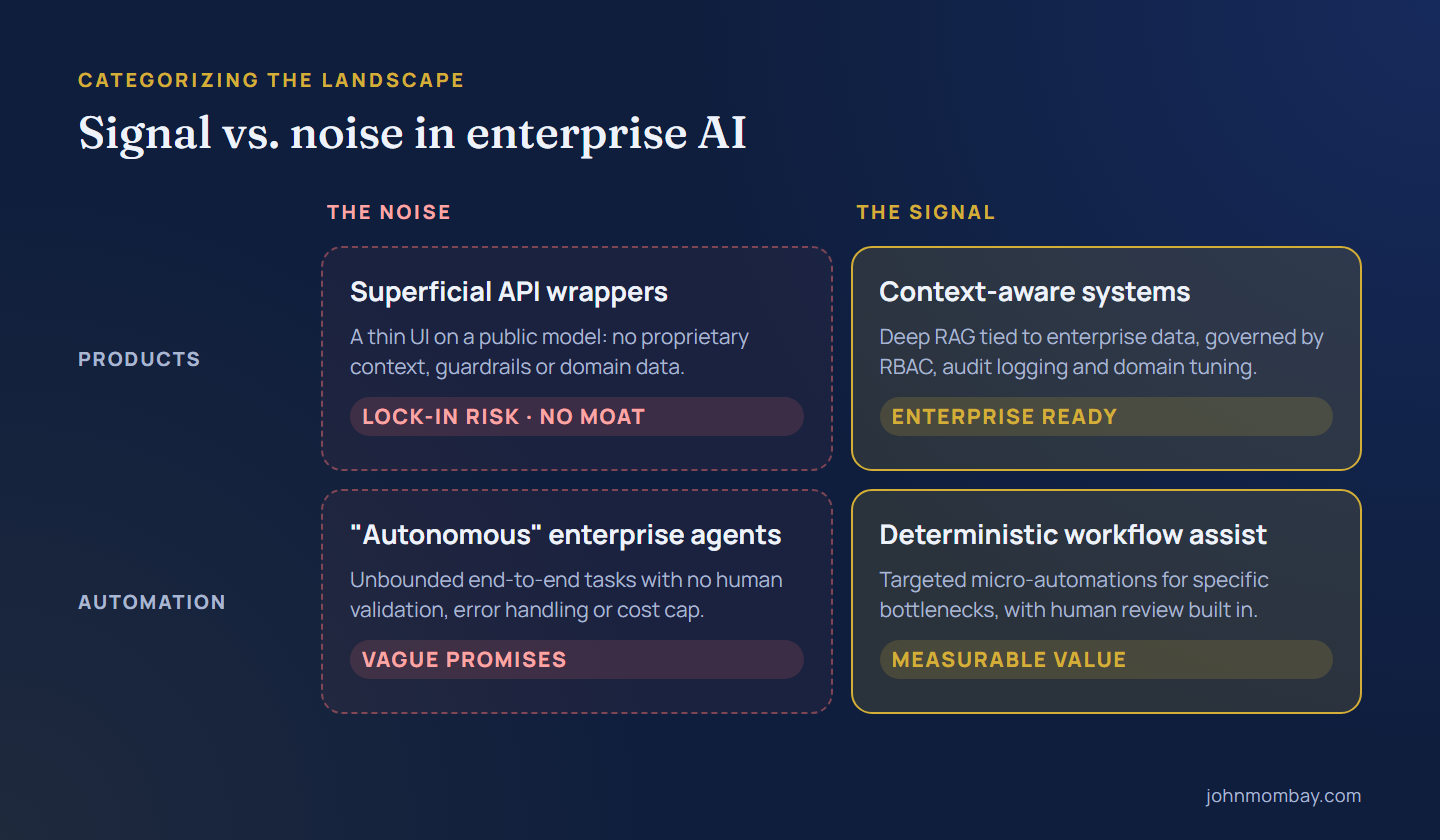
The Noise: Superficial API Wrappers
Products that add a minimal UI layer on top of public foundation models without adding proprietary context, deterministic guardrails, or domain data integration. High risk of vendor lock-in and minimal moat.
The Signal: Context-Aware Systems
Solutions integrating Deep Retrieval-Augmented Generation (RAG) tied directly to enterprise data silos, governed by strict RBAC, explicit audit logging, and domain-tuned parameters.
The Noise: "Autonomous" Enterprise Agents
Vague promises of self-directing digital workers that handle unbounded end-to-end tasks without explicit human-in-the-loop validation, structured error handling, or cost capping.
The Signal: Deterministic Workflow Assist
Targeted micro-automations designed to accelerate specific bottleneck tasks (e.g., code boilerplate, document ingestion, triage) with human review baked into the lifecycle.
2. The 4-Filter Evaluation Framework
Apply these four engineering and strategic filters to every internal pitch or external vendor proposal before committing capital or engineering resources:
Data Sovereignty & Governance Filter: Does the solution keep proprietary telemetry and customer data within your security perimeter without model training exposure?
Unit Economics Filter: Is the cost model predictable at scale, accounting for token consumption, API latency, and infrastructure compute expenses?
3. Vendor Qualification Matrix
Use this evaluation matrix during RFPs and technical discovery sessions to separate enterprise-grade solutions from speculative products.
Evaluation Vector | Red Flag (High Noise / Low Value) | Green Flag (High Signal / Enterprise Ready) |
|---|---|---|
Architecture | Opaque third-party model routing; no clear data lineage or vector DB architecture. | Clear isolation layers, self-hosted deployment options, transparent model routing. |
Pricing Model | Opaque per-seat pricing with hidden token usage overages and unbounded costs. | Transparent predictable tiering based on compute hours or indexed volume metrics. |
Security & Compliance | Vague "SOC2 planned" claims; no fine-grained role-based access control (RBAC). | Native RBAC, zero-retention SLAs, HIPAA/GDPR compliance, full audit logging. |
Implementation | Requires massive custom integration services before yielding basic functionality. | Modular plug-and-play APIs, well-documented SDKs, turnkey sandbox trials. |
Value Metric | Focuses on vague qualitative metrics like "increased creativity" or "synergy." | Measures concrete operational metrics: cycle time reduction, error rate drop, cost per ticket. |
4. Internal Strategy: Filtering the Internal Hype
External vendors are only half the equation; internal teams often propose AI initiatives driven by novel technology rather than concrete operational needs. Establishing a disciplined internal governance framework prevents resource fragmentation.
The "ROI First, AI Second" Protocol
Mandate that all internal AI project proposals identify the business problem using traditional metrics (e.g., "Reduce L1 customer support escalation time by 25%") prior to selecting a technology solution. If traditional automation or a simple database query solves the problem faster and cheaper, decline the AI project.
5. Executive Decision Checklist
Before allocating budget or technical bandwidth to a new AI initiative, verify that the project meets the following criteria:
Clear Baseline: Existing process performance and costs are accurately benchmarked.
Fallback Plan: A deterministic non-AI system exists if model outputs fail or degrade.
Security Approval: Data pipeline and model interaction comply fully with enterprise risk standards.
Total Cost of Ownership (TCO): Storage, inference, maintenance, and retraining costs are factored into 3-year projections.
Human-in-the-Loop Architecture: High-risk decisions require explicit human review points.
No comments yet. Be the first to share a thought.