The AI-Native Startup: How Capital Efficiency and Team Structure Are Being Rewritten
When the cost of writing software drops toward zero, seed money stops buying engineering headcount. How AI-native teams, moats and venture capital are changing, and a playbook for founders.
 4 min read
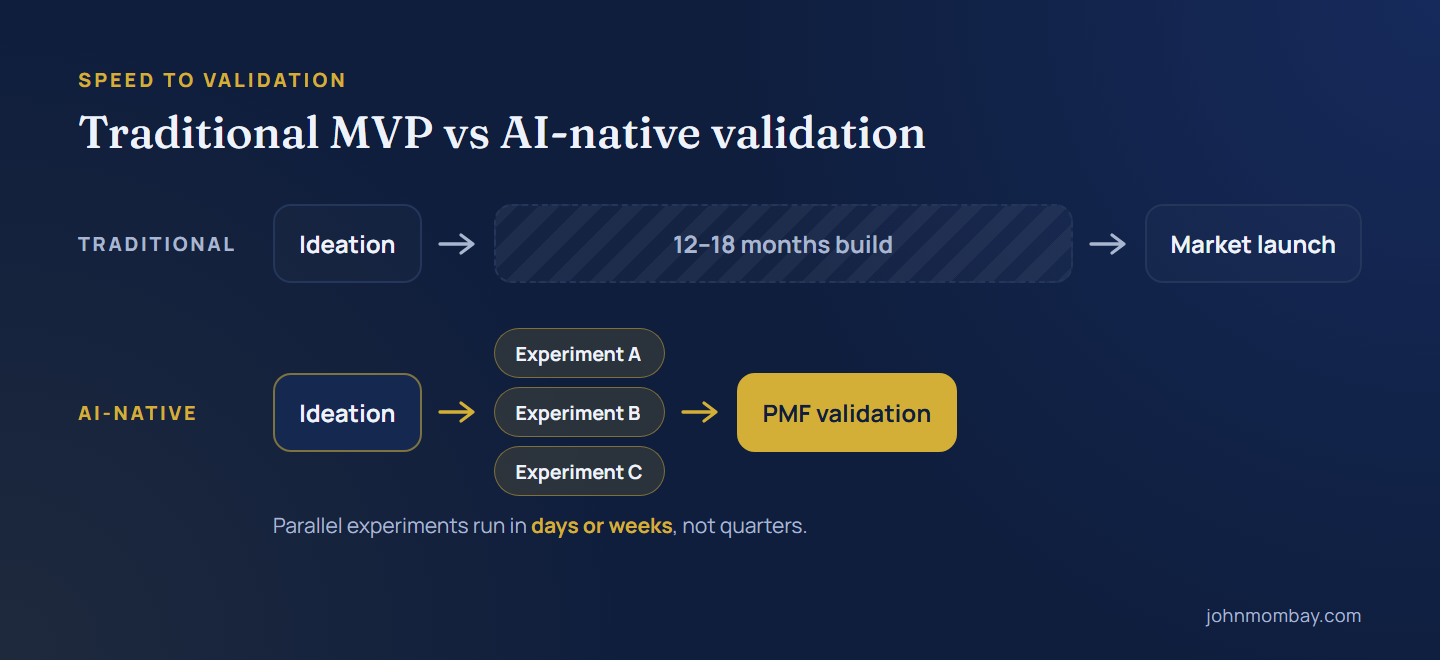
For decades, the mechanics of founding an early-stage technology startup followed a well-documented playbook. Raising a seed round was fundamentally an exercise in purchasing engineering runway: securing $1.5M to $3M to hire 5 to 10 full-stack software engineers, a product manager, and a UI/UX designer to build a Minimum Viable Product (MVP) over 12 to 18 months.
In an AI-native ecosystem, that classic paradigm is obsolete.
When the marginal cost of software execution drops toward zero, the economic physics governing startup formation, capital allocation, and team scaling undergo a fundamental transformation.
We are transitioning from the traditional Software Development Life Cycle (SDLC) to an AI-Native Engineering Model.
1. The Collapse of the Early-Stage Engineering Team
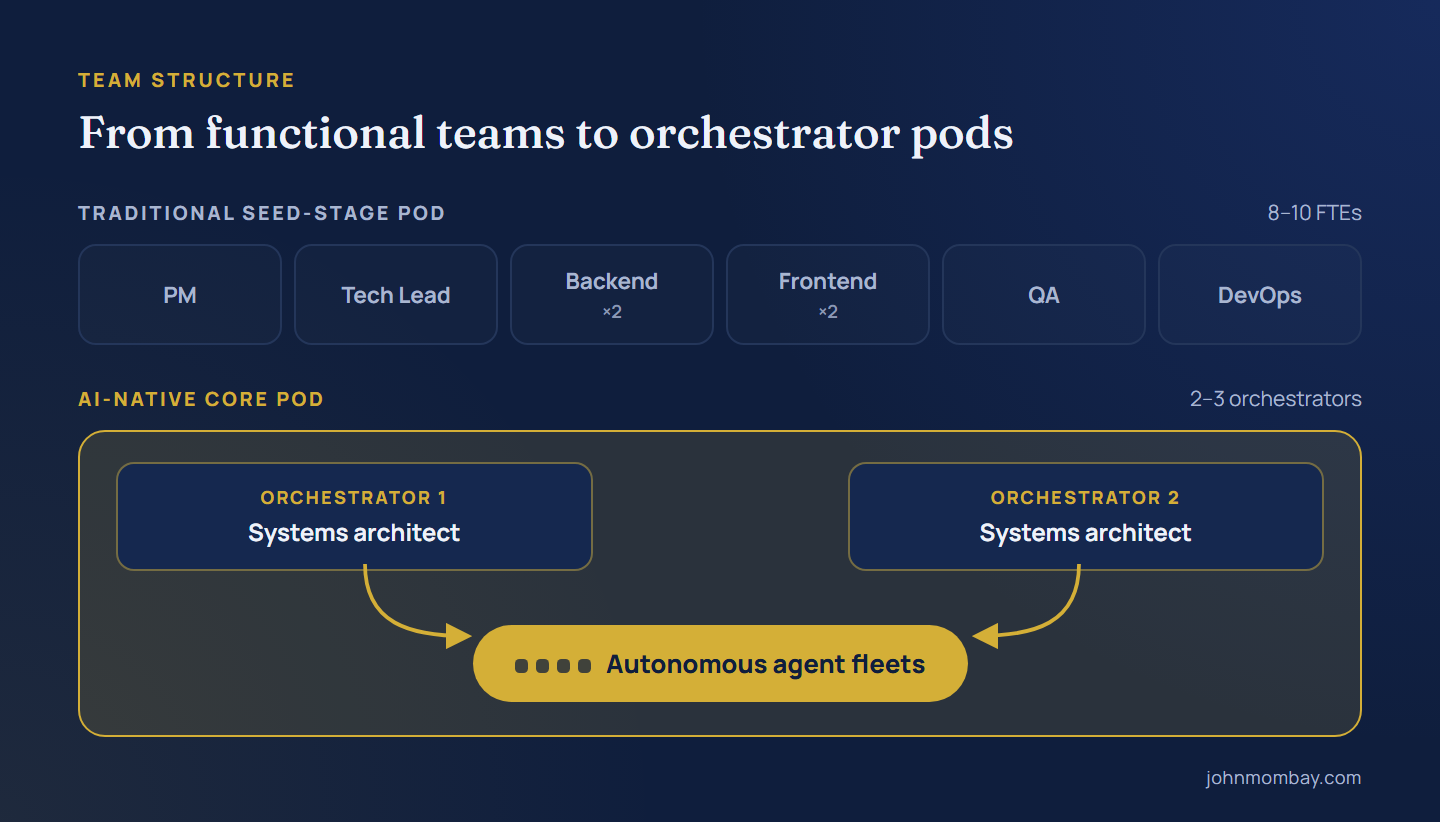
The traditional early-stage tech company structure was built around functional division of labor: Product Managers defining specs, Frontend and Backend Engineers writing syntax, QA Engineers writing tests, and DevOps Engineers managing infrastructure.
In AI-native organizations, this hierarchical structure is collapsing into hyper-lean, multi-disciplinary pods.
The Rise of the Hyper-Lean Core
Pre-seed startups no longer require a full engineering department to reach Product-Market Fit (PMF). Foundational teams composed of 2 to 3 systems-focused co-founders can build, deploy, and iterate production-grade platforms that previously demanded an engineering team of ten.
Expanded Scope via Agentic Orchestration
Rather than manually writing syntax line by line, modern engineers act as system orchestrators. Leveraging autonomous agent fleets, spec-driven development frameworks (spec.md), and repository-level system instructions (.cursorrules), a single engineer can maintain output equivalent to an entire legacy software division.
Re-Allocation of Venture Capital
Because capital is no longer consumed by baseline developer headcount, early-stage venture capital is shifting. Investors are evaluating startups based on proprietary operational context, evaluation benchmarks, distribution efficiency, and domain data pipelines rather than engineering burn rate.
2. Speed to Validation: Software Capability Is No Longer the Moat
In traditional software development, the ability to build complex features served as a defensible barrier to entry. In an era where autonomous agents can scaffold microservices, generate API integrations, and write frontend components in hours, "Can you build this?" is no longer a valid strategic moat.
From Quarters to Days: The New Execution Velocity
Minimum Viable Products move from concept to production deployment in days rather than quarters. This compression enables founding teams to run parallel market experiments, testing real demand across distinct user segments simultaneously before committing to a permanent system architecture.
What Constitutes a Defensible Moat Today?
If code execution is commoditized, defensibility shifts to three distinct layers:
Domain-Specific Context: Proprietary workflow logic, curated prompt/rule instructions (
.cursorrules), and fine-tuned domain context that general-purpose AI systems cannot replicate.Evaluation & Benchmark Infrastructure: Custom test suites and domain benchmarks that validate AI reliability and prevent system degradation under real-world conditions.
Deep Customer & Workflow Integration: High-trust software positioning embedded directly within critical enterprise data flows.
3. The AI-Native Operating Playbook
Building an agile, highly scalable startup in the AI era requires an operational shift in hiring, system design, and software governance.
Imperative 1: Hire Systems Architects, Not Syntax Coders
Early-stage technical hires must possess deep systems design capabilities, domain logic, and prompt/agent orchestration skills. The core competency of a modern engineer is directing machine intelligence, evaluating AI outputs, and architecting resilient systems.
Imperative 2: Build Context-First Infrastructure
Establish standardized project specifications (spec.md) and repository governance rules from Day 1. Clear system constraints ensure autonomous agents generate compliant, maintainable, and secure code as the codebase expands.
Imperative 3: Invest in Evaluation Suites Early
When software is generated at agentic speeds, technical debt can accumulate exponentially. Automated regression testing, continuous evaluation suites, and agent monitoring pipelines must be deployed early to ensure system stability and security.
Strategic Summary: The Future of High-Yield Software
AI-native engineering does not signal the decline of technology startups; it triggers an explosion of smaller, highly capital-efficient enterprises competing on a global scale.
The winning founders of this era will not be those who scale headcount the fastest, but those who effectively orchestrate machine intelligence, architectural intent, and strategic context.
No comments yet. Be the first to share a thought.