Beyond Digitalization: The Executive Playbook for Intelligent Transformation
Digitizing a flawed process only makes friction faster. Why intelligent transformation is 20% technology and 80% change management, and a three-phase playbook for leaders.
 5 min read
For over a decade, enterprise leaders followed a familiar, predictable roadmap for digital transformation. It meant migrating legacy architecture to the cloud, converting paper-based forms into web portals, and implementing enterprise software suites.
By 2026, that playbook reached its operational ceiling.
Digitizing a flawed, manual process without rethinking underlying intelligence yields only one result: a faster, more expensive version of bureaucratic friction.
We have officially transitioned from Digital Transformation to Intelligent Transformation.
The sustainable competitive advantage no longer lies in merely collecting or hosting digitized data. It lies in how seamlessly an enterprise integrates artificial intelligence into its core decision-making loops, operational workflows, and organizational culture.
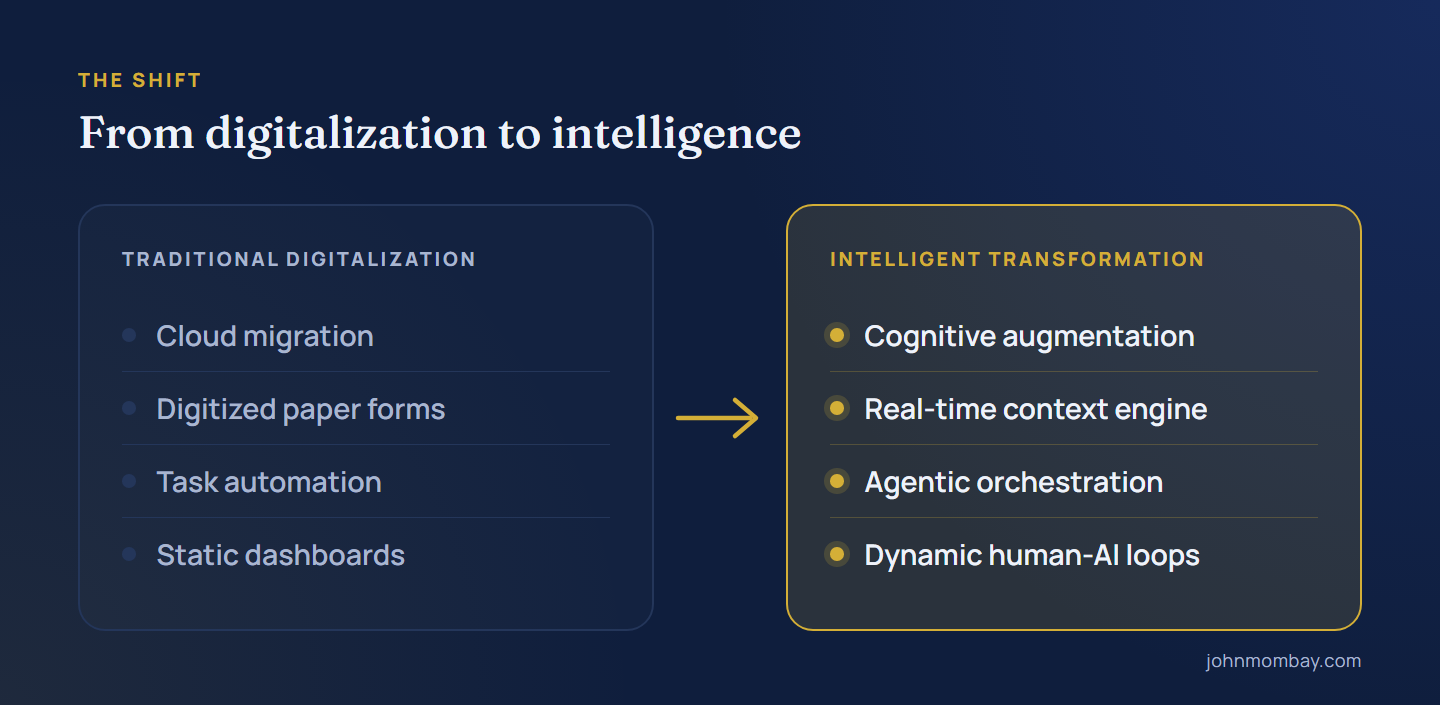
The Strategic Shift: Digitalization vs. Intelligence
To lead through this evolution, executive teams must distinguish between legacy IT modernization and AI-native architecture.
Strategic Dimension | Traditional Digitalization | Intelligent Transformation |
|---|---|---|
Core Objective | System availability & cloud migration | Continuous intelligence & cognitive leverage |
Data Architecture | Historical reporting & compartmentalized storage | Unified context layers & real-time ingestion |
Workforce Dynamic | Software replacing manual data entry | AI agents augmenting human judgment |
Primary Failure Point | Budget overruns & implementation delays | Trust deficits, data hoarding, & cultural friction |
When moving from basic software upgrades to intelligent orchestration, business leaders must realign three core pillars: Augmentation over Automation, Data Infrastructure, and Psychological Safety.
Pillar 1: Augmentation Over Automation
A common strategic trap in early enterprise AI adoption is evaluating technology purely through a cost-reduction lens—aiming to automate entire job descriptions out of existence.
True transformation focuses on cognitive augmentation.
1. Augmentation Expands Operational Capacity
Automation seeks to cut costs by eliminating human touchpoints. Augmentation strips away administrative friction—data parsing, initial drafting, complex routing, and preliminary research—enabling domain experts to operate at significantly higher strategic leverage.
2. Redefining Value Metrics
Success metrics must shift from simple hours saved to output quality, scale, and decision velocity. Saving five hours a week offers zero enterprise value if those hours are absorbed by adjacent administrative noise.
3. Human-in-the-Loop Governance
Autonomous AI agents scale execution speed, but enterprise accountability remains fundamentally human. Modern system architecture must enforce a structure where AI proposes context and recommendations while human teams make decisions and retain governance.
Pillar 2: The 80/20 Rule of Enterprise AI
Multi-million dollar AI initiatives rarely fail due to model limitations. They fail because of legacy data bottlenecks and organizational inertia.
Intelligent Transformation is 20% technology and 80% change management.
Deploying advanced large language models or multi-agent orchestration layers onto fractured foundations creates three predictable structural failure modes:
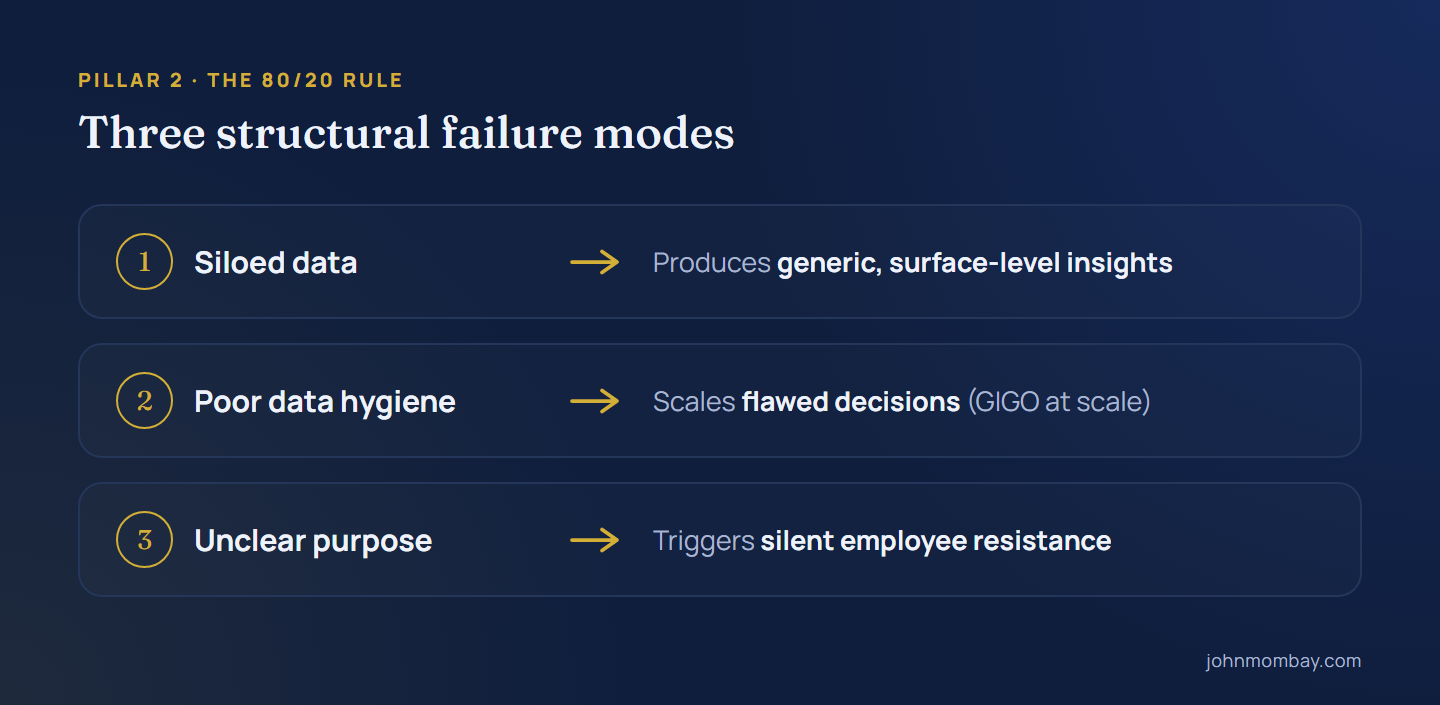
Trapped Data Yields Surface-Level Output: When operational context is isolated inside departmental silos, AI models operate in a vacuum, generating generic strategy instead of actionable intelligence.
Poor Data Hygiene Scales Flawed Decisions (GIGO at Scale): Garbage In, Garbage Out (GIGO) is magnified in the AI era. In legacy IT, dirty data broke a static dashboard. In an AI architecture, bad data poisons vector indexes, corrupts Retrieval-Augmented Generation (RAG) pipelines, and outputs confident hallucinations.
Unclear Positioning Triggers Silent Resistance: When teams perceive AI as a threat to their autonomy or job security, adoption stalls regardless of interface quality.
Pillar 3: Psychological Safety as Data Architecture
A major oversight in enterprise deployment is treating psychological safety strictly as a soft HR concept. In reality, psychological safety is a prerequisite for reliable data architecture.
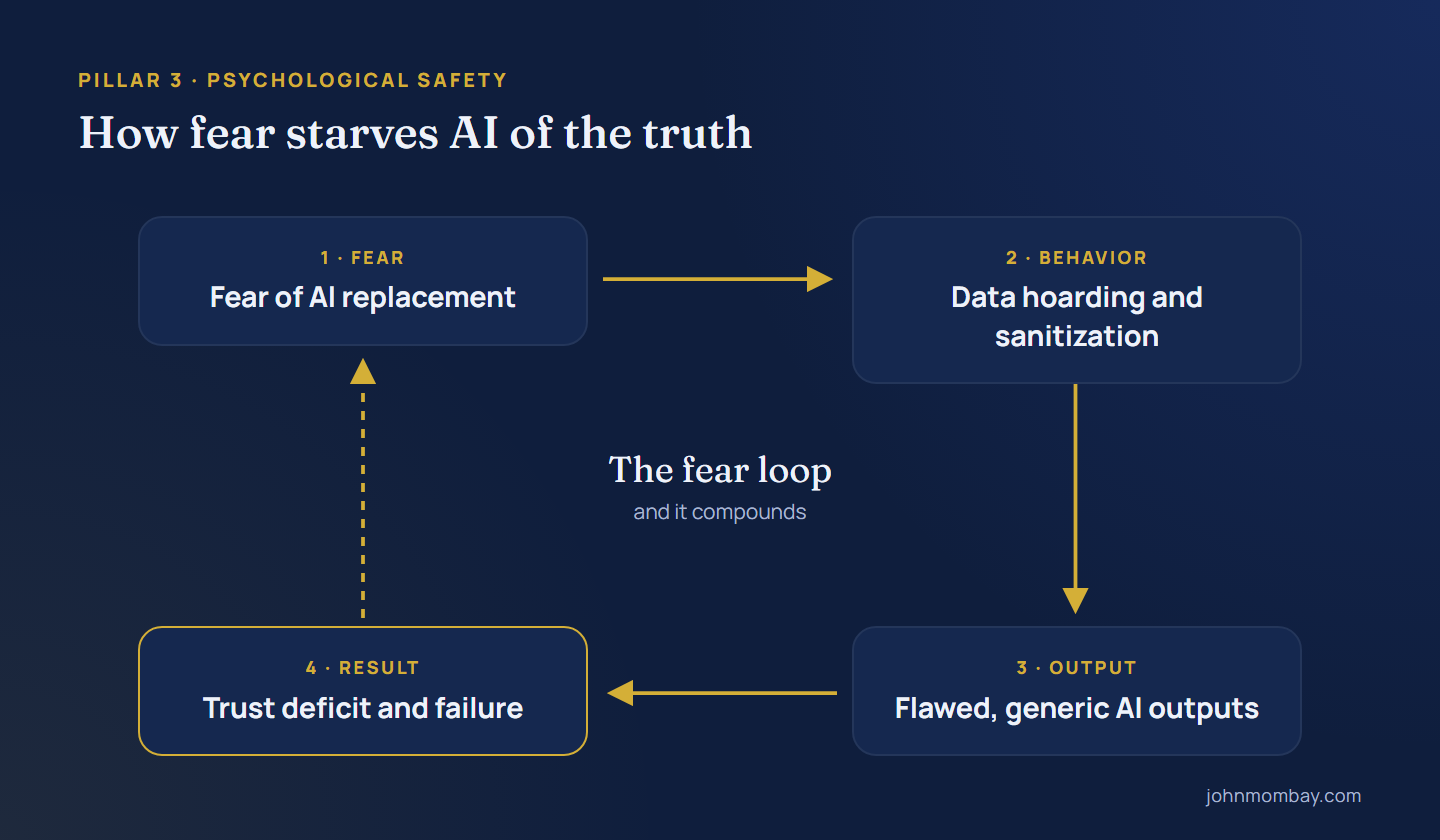
When fear governs a workplace:
Employees hoard tribal knowledge to maintain individual indispensability.
Teams manually sanitize inputs before uploading them, hiding operational friction.
Staff withhold raw edge cases that expose legacy workarounds.
This behavior starves AI pipelines of ground-truth reality. A pipeline fed on sanitized data produces flawed outputs. When executive teams see those flawed outputs, a trust deficit forms, compounding skepticism across the organization.
Data governance cannot be fixed through code alone if the corporate culture incentivizes hiding operational reality.
The Executive Playbook: A 3-Phase Execution Roadmap
Sequencing matters far more than resource allocation. Building an intelligent enterprise requires executing three operational phases in precise order:
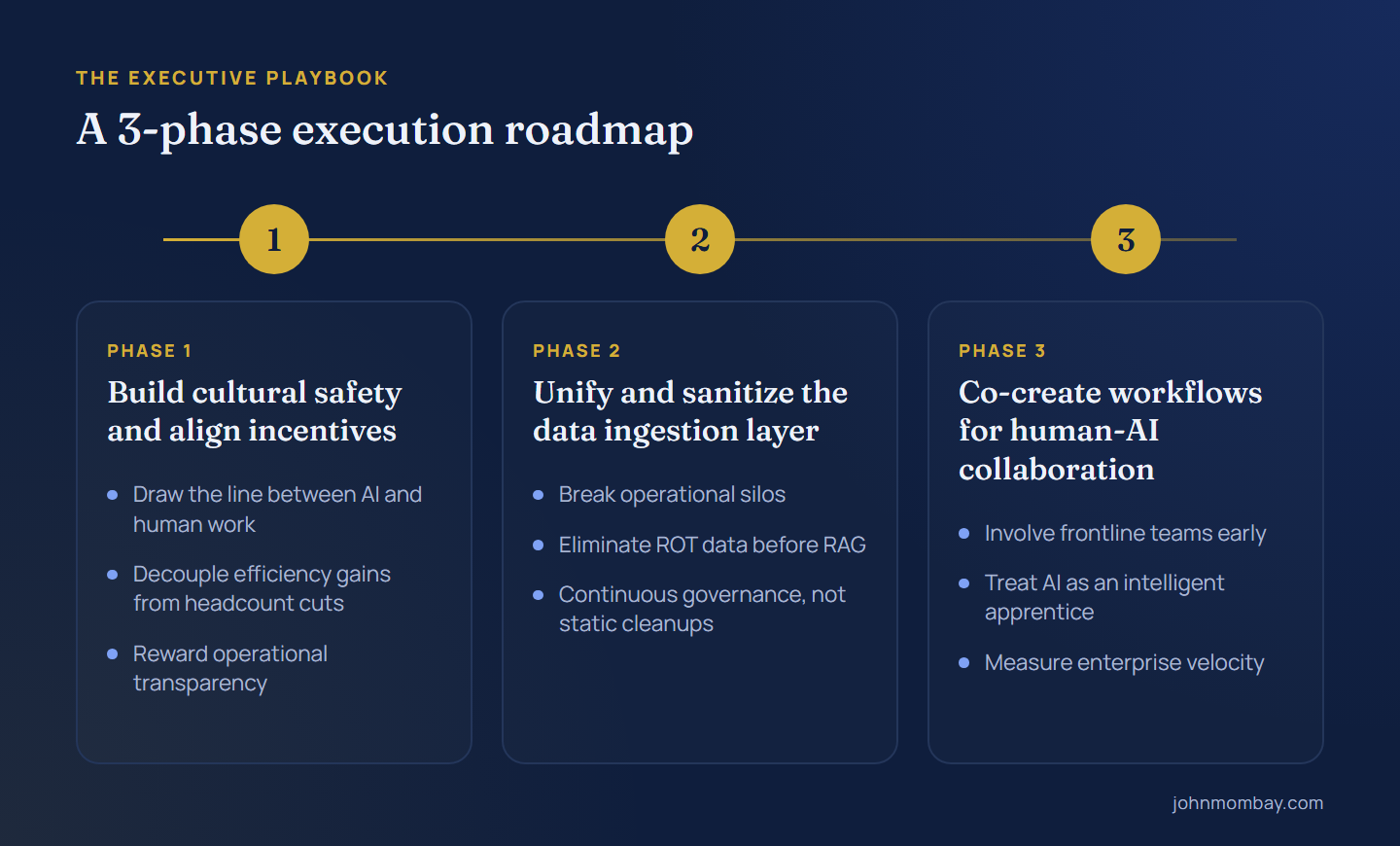
Phase 1: Build Cultural Safety & Align Incentives
Explicitly Draw the Line: Clearly define what AI will handle (data synthesis, initial draft generation, administrative noise) versus what humans exclusively own (strategy, ethics, nuance, and final decisions).
Decouple Efficiency Gains from Headcount Reduction: Guarantee that productivity wins are reinvested into team capacity expansion rather than immediate head-count cuts.
Reward Operational Transparency: Actively praise teams that expose raw, messy operational inputs and legacy workarounds over those presenting artificially polished status reports.
Phase 2: Unify & Sanitize the Data Ingestion Layer
Break Operational Silos: Consolidate structured and unstructured databases into secure, accessible context layers so AI models access genuine institutional knowledge.
Eliminate ROT Data: Clear Redundant, Obsolete, and Trivial (ROT) data before connecting RAG pipelines or autonomous agents to prevent system poisoning.
Continuous Governance over Static Cleanups: Treat data hygiene as an ongoing operational discipline rather than an annual IT project.
Phase 3: Co-Create Workflows for Human-AI Collaboration
Involve Frontline Teams Early: Give domain experts direct agency over prompting, testing, and setting guardrails during initial pilots.
Treat AI as an Intelligent Apprentice: Structure workflows where AI systems generate options, synthesize context, and handle execution details, while domain leaders review, refine, and sign off.
Measure Enterprise Velocity: Track success through decision speed, output quality, and enterprise scalability rather than raw software adoption metrics.
The Path Forward
Intelligent Transformation is not an isolated IT project or a temporary software upgrade—it is an enterprise-wide operational evolution.
Organizations that focus solely on model selection while ignoring data hygiene and psychological safety will find themselves automating confusion.
Leaders who establish cultural safety, clean their underlying data pipelines, and design workflows around human-AI augmentation will build agile, high-trust enterprises built to lead in the AI era.
No comments yet. Be the first to share a thought.