Vibe Coding vs. AI-Assisted Software Engineering
Vibe Coding optimizes for speed; AI-Assisted Software Engineering puts AI inside rigorous architecture. How enterprise leaders can balance velocity with security and scalability.
 5 min read
Executive Summary: The generative AI revolution has bifurcated software creation into two distinct operational paradigms: Vibe Coding (an intuition-led, prompt-driven approach optimized for speed) and AI-Assisted Software Engineering (a structured, system-aware discipline leveraging AI within rigorous architectural frameworks). Enterprise tech leaders must navigate this divide to balance velocity with security and scalability.
1. Defining the Paradigms
As Artificial Intelligence transforms software creation, the industry faces an identity shift. The line between conceptualizing logic and implementing syntax has blurred, leading to two fundamental modalities of development.
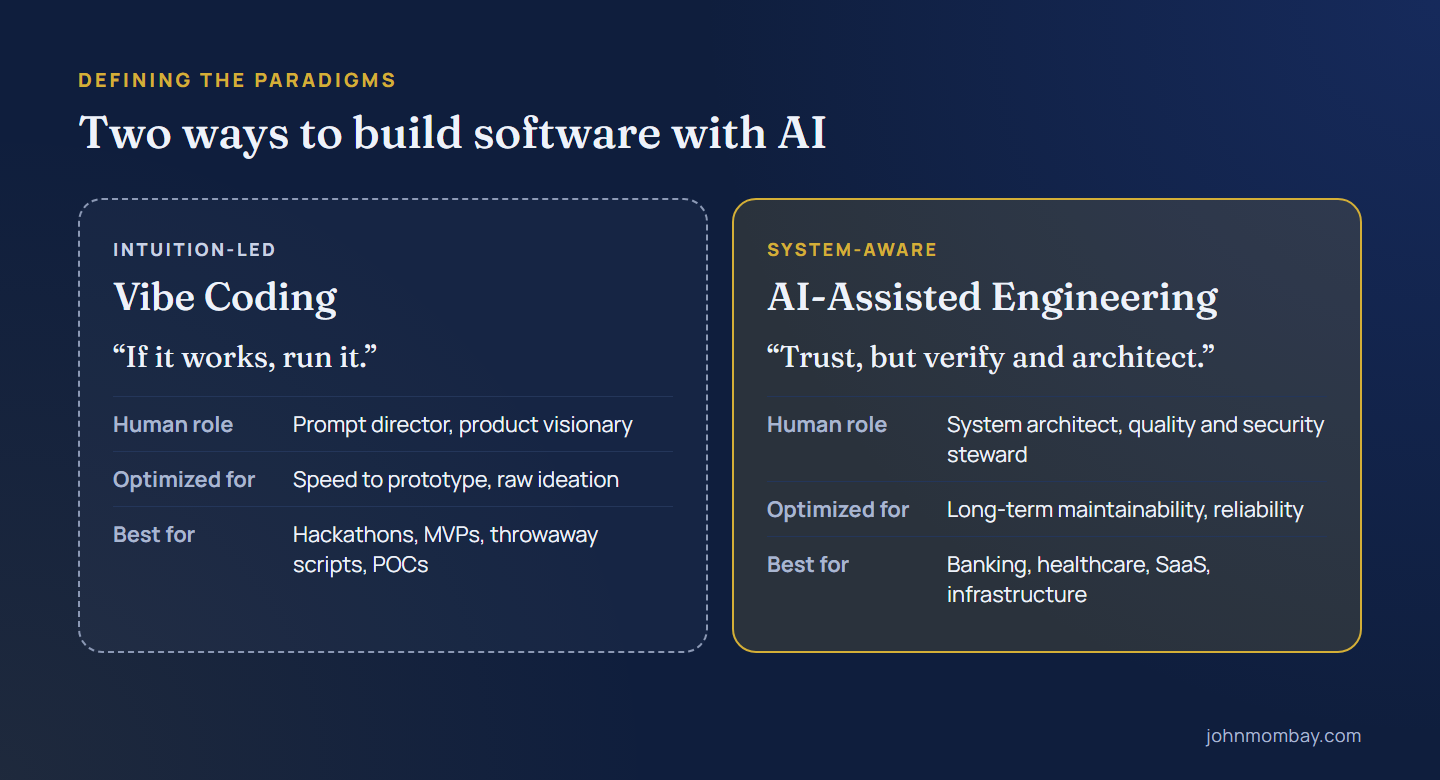
Vibe Coding
Concept: Coined informally to describe a workflow where human developers offload execution entirely to AI models, guiding software creation through high-level intent, natural language prompts, and iterative feedback without closely inspecting the generated codebase.
Core Philosophy: "If it works, run it." The human acts as an orchestrator and visionary, prioritizing rapid iteration, immediate outcomes, and dynamic trial-and-error over deep syntactic mastery.
AI-Assisted Software Engineering
Concept: A formal engineering methodology where Large Language Models (LLMs) and intelligent agents act as force multipliers within traditional, rigorous Software Development Life Cycles (SDLC).
Core Philosophy: "Trust, but verify and architect." AI handles boilerplate, inline completion, and routine refactoring, but humans retain full ownership of system design, security, maintainability, and code review.
2. Strategic Comparison Matrix
Understanding the architectural, operational, and financial dimensions of both approaches is vital for technology decision-makers.
Dimension | Vibe Coding | AI-Assisted Engineering |
|---|---|---|
Primary Goal | Maximum speed-to-prototype, raw ideation | Long-term maintainability, enterprise reliability |
Human Role | Prompt Director / Product Visionary | System Architect / Quality & Security Steward |
Code Quality | Variable; prone to debt & hallucinated logic | High; validated via strict CI/CD, tests, & review |
Domain Fit | Hackathons, MVPs, throwaway scripts, POCs | Core banking, Healthcare, SaaS, Infrastructure |
Risk Profile | High: Hidden bugs, security vulnerabilities | Managed: Controlled via human governance |
3. Comprehensive Trade-Off Analysis
Both modalities present unique strengths and critical risks. Evaluating these trade-offs ensures organizations deploy the right approach for the appropriate application tiers.
Vibe Coding: Advantages
Unmatched Velocity: Go from vague idea to working prototype in hours rather than weeks.
Democratized Creation: Enables non-technical domain experts to generate functional software interfaces.
Frictionless Ideation: Rapidly test multiple hypotheses and user interfaces with minimal setup costs.
Vibe Coding: Drawbacks
Architectural Decay: Generates monolithic, unorganized code bases ("spaghetti code") that deteriorate quickly.
Security Blindspots: High risk of introducing unvetted dependencies, hardcoded credentials, and OWASP top-10 flaws.
Debugging Nightmare: When things break, creators lack deep contextual understanding to fix underlying root causes.
AI-Assisted Engineering: Advantages
Sustainable Productivity: Delivers 30%–50% efficiency gains while upholding engineering standards.
Robust Security & Compliance: Ensures code meets enterprise regulatory, audit, and governance bars.
Enhanced System Resilience: Integrates thorough automated testing, refactoring, and clear documentation.
AI-Assisted Engineering: Drawbacks
Higher Onboarding Overhead: Requires structured developer training, static analysis tooling, and policies.
Slower Prototyping: Initial boilerplate setup and rigorous code reviews take more time than pure prompting.
Model Context Limits: Enterprise architectures often exceed simple LLM context windows, needing explicit curation.
4. Operational Metrics Impact
Industry benchmarking reveals stark differences in operational health depending on which methodology dominates an engineering organization.
+310% initial prototype speed (Vibe Coding)
+240% long-term tech debt (Vibe Coding)
+45% net dev output (AI-Assisted)
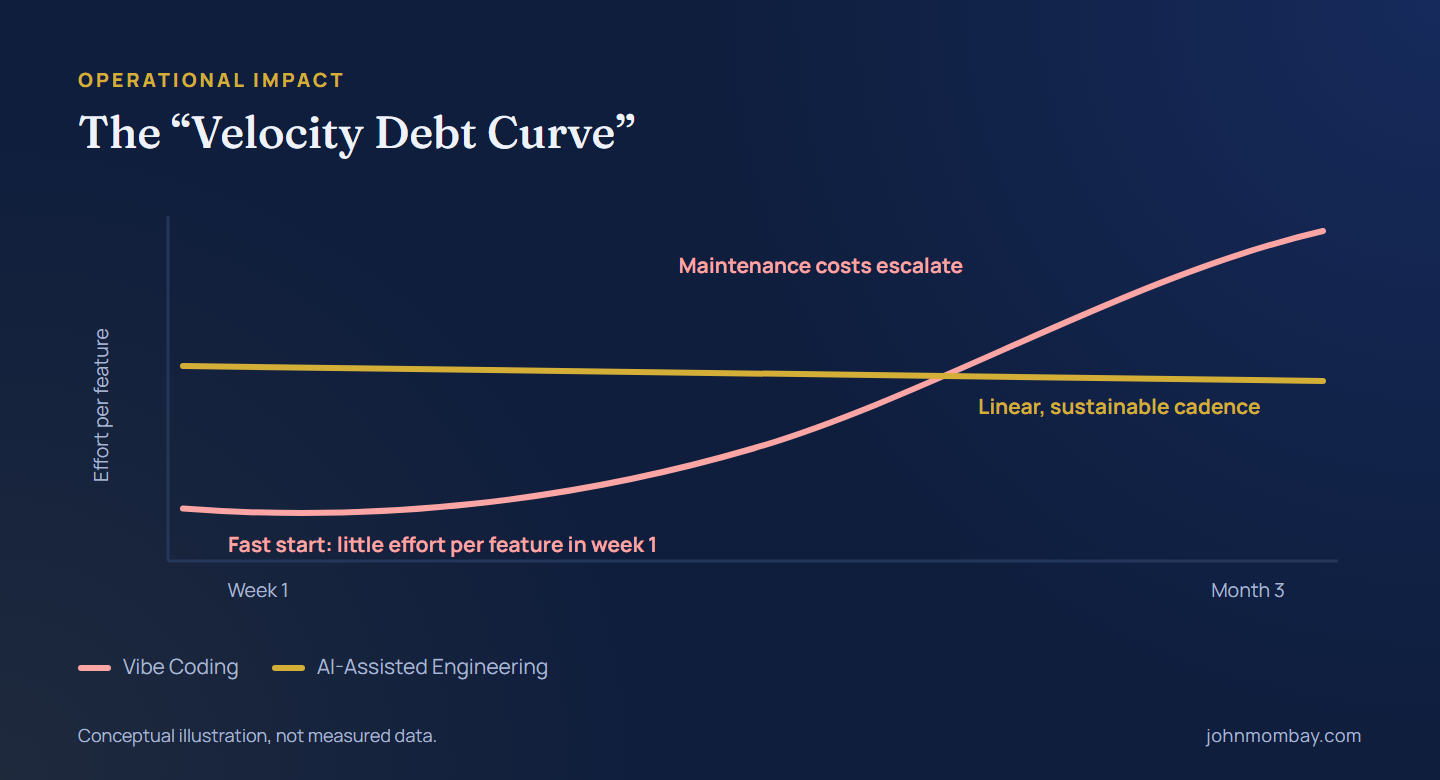
Key Insight: Vibe Coding creates a "Velocity Debt Curve." While output spikes significantly in Week 1, maintenance costs escalate exponentially by Month 3 due to accumulated architectural inconsistencies. AI-Assisted Engineering maintains a linear, sustainable delivery cadence.
5. Enterprise Adoption Strategy: What Should Leaders Adopt?
Enterprises should not treat this as a binary choice. The optimal strategy lies in a Bimodal Adoption Model, leveraging Vibe Coding for low-risk innovation while mandating AI-Assisted Software Engineering for core production systems.
The Enterprise AI Integration Framework
Sandbox & Innovation Labs (Vibe Coding Approved): Allow product managers, designers, and innovation teams to vibe code internal tools, rapid UI mockups, and client proof-of-concepts. Rule: Code generated here is strictly non-production and subject to teardown.
Production & Mission-Critical Tier (AI-Assisted Required): Enforce strict AI-Assisted Engineering protocols. All AI-generated code must pass static analysis (SonarQube), security scanning (Snyk), automated unit tests, and peer review by senior engineers.
Governance & Attribution: Establish enterprise guidelines regarding intellectual property, data privacy (preventing leaks to public LLMs), and licensing risks associated with AI-generated snippets.
6. Why Software Engineers Are More Essential Than Ever
A common misconception is that AI code generation makes software engineers redundant. In reality, AI raises the stakes for real engineering expertise. When code generation becomes free and abundant, the value shifts from writing syntax to system design, judgment, and validation.
1. Architectural Vision & Scale
AI models generate localized code snippets effectively, but struggle with macro-level architecture, distributed system trade-offs (CAP theorem, latency vs. throughput), and long-term domain modeling. Engineers design the cohesive blueprints.
2. Security & Accountability
LLMs inevitably hallucinate subtle bugs and reintroduce legacy vulnerabilities. An AI cannot be held accountable for a data breach or system crash; ultimate legal, ethical, and operational accountability rests entirely on human engineers.
3. Domain Translation & Nuance
Translating complex, ambiguous business specifications into precise technical requirements remains a uniquely human skill. Engineers bridge business intent with deterministic execution.
4. System Maintenance & Debugging
When multi-service cloud infrastructure fails under unexpected traffic spikes, fixing it requires deep mental models of the stack. Engineers who rely only on "vibes" cannot debug complex distributed failures.
Conclusion
AI is transforming software engineering from a discipline of syntax composition to one of orchestration, curation, and architectural stewardship. Organizations that invest in skilled software engineers equipped with AI tools will build resilient, scalable futures—while those relying solely on unvetted code generation will flounder under technical debt.
No comments yet. Be the first to share a thought.