The Inverted Build-Measure-Learn Loop: Software Development in the Autonomous AI Era
The Lean Startup loop was built for a world where building took months. Now learning comes first, building takes minutes, and measuring is real-time. What that means for product leaders.
 4 min read
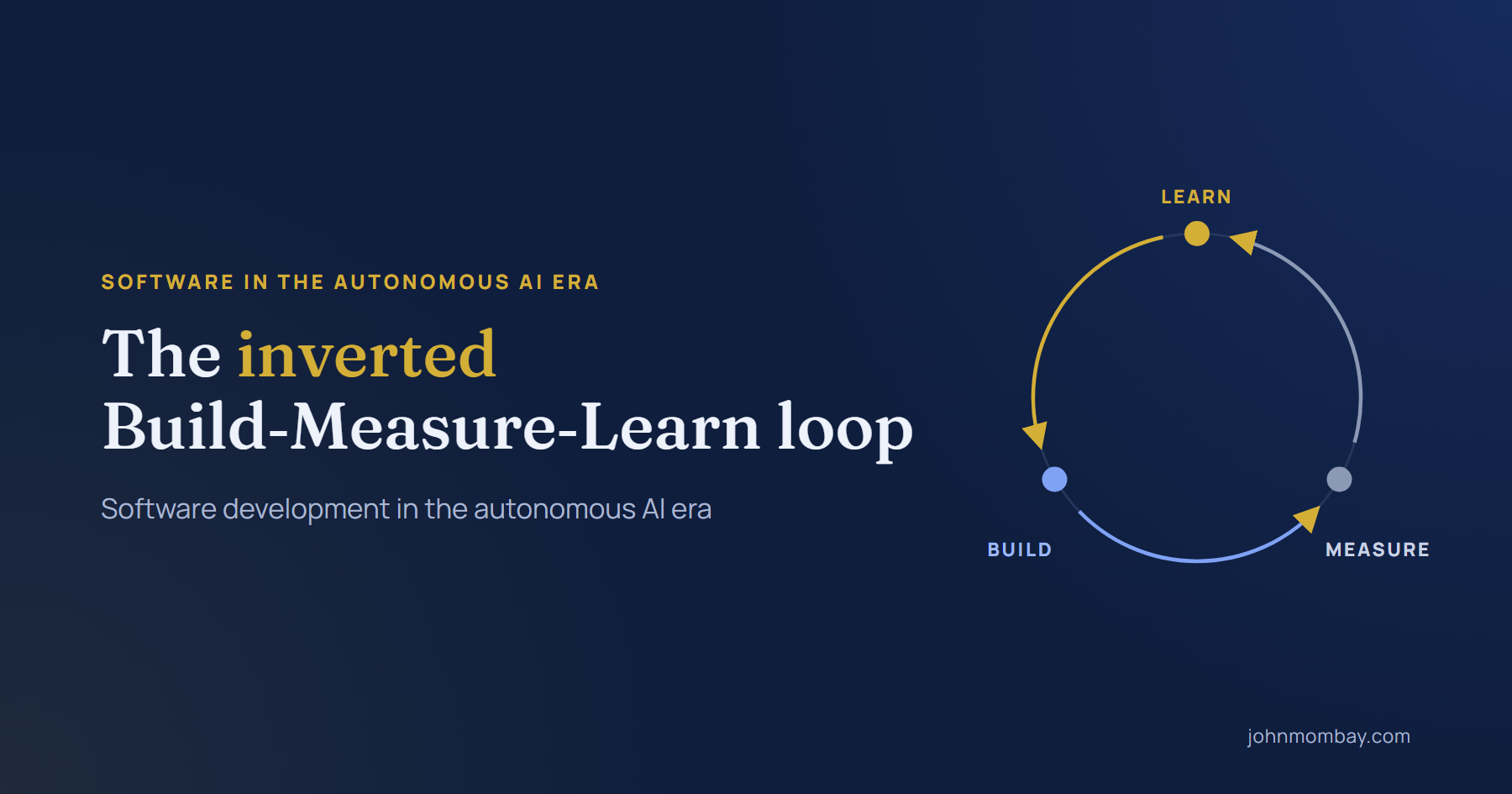
In 2011, Eric Ries codified a framework that defined a generation of technology startups: The Lean Startup. At its core was the Build-Measure-Learn feedback loop. For over a decade, this operational engine drove product management, venture capital allocation, and agile software development.
However, the temporal dynamics of that feedback loop have collapsed:
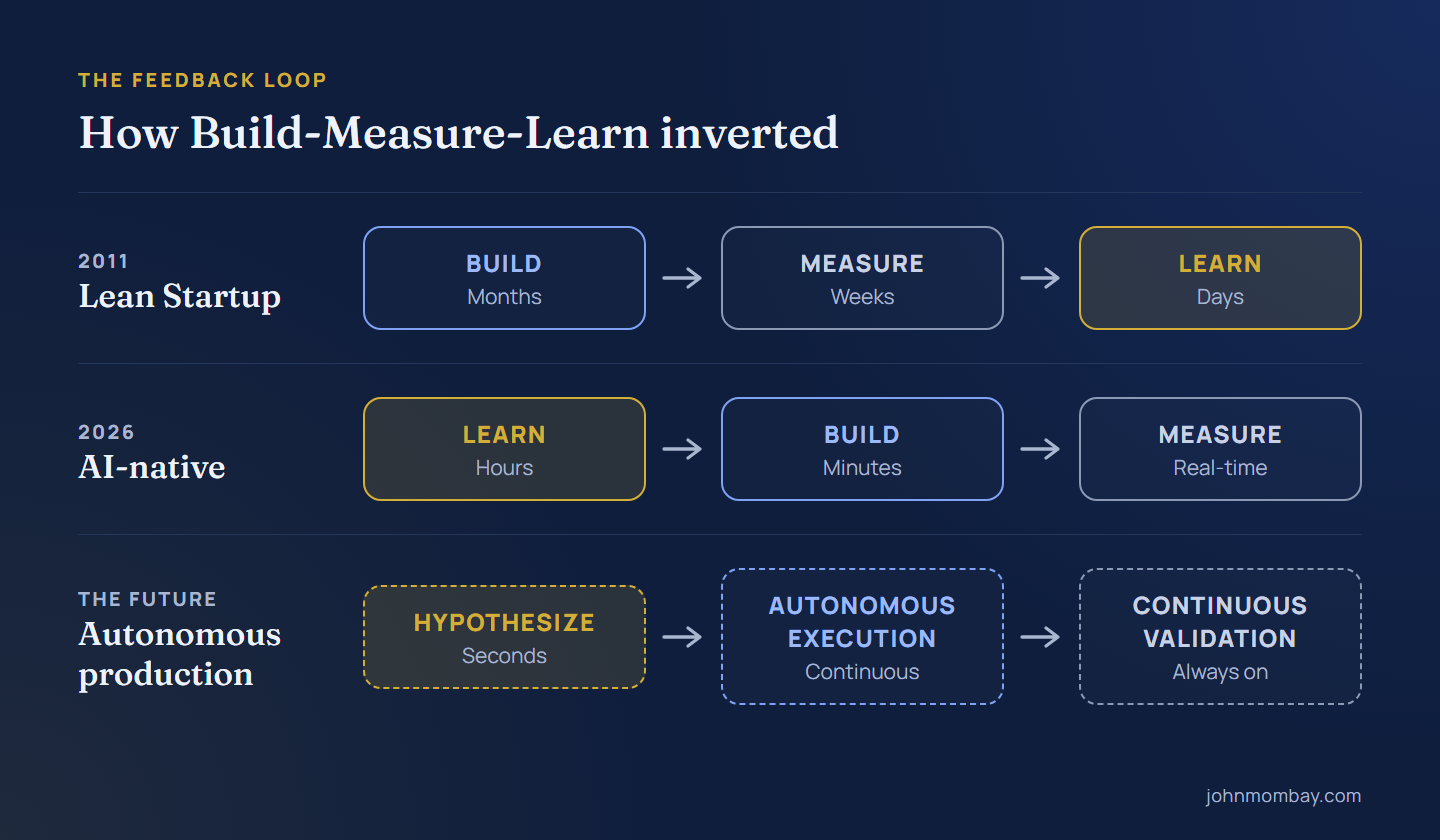
The Lean Startup philosophy—treating a company as a series of scientific experiments—isn't dead. However, its underlying mechanics have completely inverted.
The Historical Bottleneck Collapse
To understand where software architecture is heading, we must analyze why the feedback loop inverted in the first place.
Era | Primary Bottleneck | Cost of Iteration | Time to MVP | Sunk-Cost Fallacy Risk |
|---|---|---|---|---|
Traditional (2011) | Software Execution (Engineering) | Very High ($100k+) | 3 to 6 Months | Critical (Hard to pivot away from months of manual code) |
AI-Native (2026) | Clarity & Strategy (Intent) | Low (Token/Inference cost) | Minutes to Hours | Minimal (Code generated in an afternoon carries zero emotional weight) |
Autonomous Era (Future) | Domain Logic & Market Alignment | Marginal | Real-Time / Continuous | Zero (Ephemeral software built and discarded dynamically) |
In the traditional startup playbook, Building was the primary economic bottleneck. Writing clean, maintainable code required high-capital engineering teams. MVPs took quarters to ship. Because getting to Version 1.0 consumed massive financial and human runway, founders routinely fell victim to the sunk-cost fallacy, holding onto flawed product concepts far too long.
Today, AI code agents, spec-driven execution pipelines, and foundational models have driven the marginal cost of writing baseline syntax close to zero.
Three Shifts Reshaping Modern Product Building
1. From Execution Bottlenecks to Clarity Bottlenecks
Generating software faster does not guarantee Product-Market Fit (PMF); it can just as easily generate lightspeed technical debt. When anyone can deploy a full-stack web application in an afternoon, product strategy, deep customer discovery, and precise system specifications become the only real leverage.
The bottleneck has moved entirely from how to code to what to build and why.
2. Frictionless Pivots and Experiment Density
Discarding code generated in hours carries zero financial or emotional friction. When feedback loops shrink from quarters to days, early-stage teams can execute 10x more product experiments within the same runway, rapidly accelerating the timeline to validated learning.
3. The Mutation of the MVP
Testing whether a software feature can be engineered is obsolete. A modern Minimum Viable Product must evaluate three distinct criteria:
Unit Economic Viability: Inference & compute costs versus actual customer value created.
Context Integration: How deeply the product ingests and leverages proprietary domain data.
Long-Term Retention: Sustained workflow embedding rather than novel interface usage.
Looking Ahead: The Shift to Autonomous Concept-to-Production
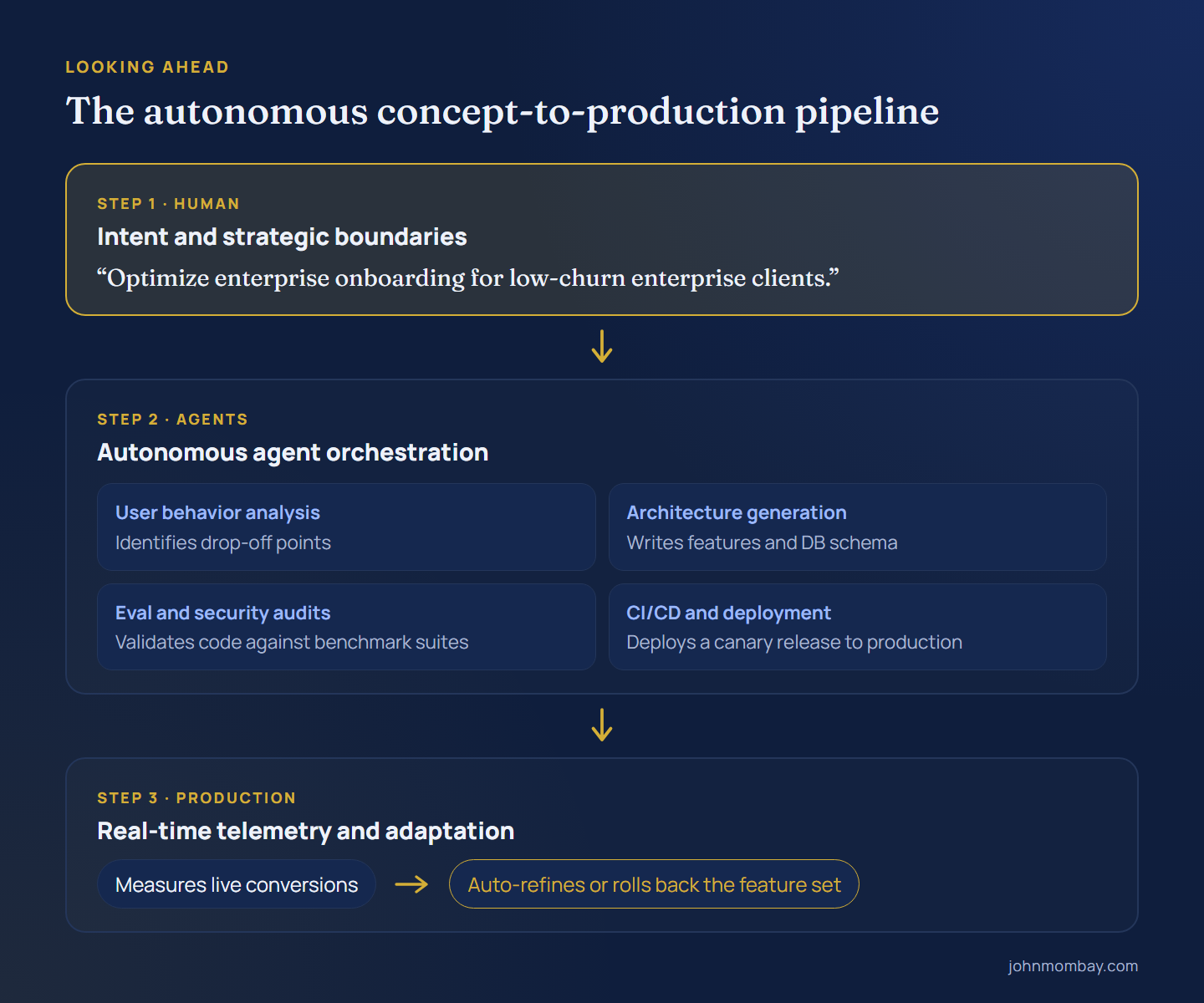
While today’s workflows rely on human orchestrators directing AI agents through specification files and evaluation pipelines, we are rapidly approaching the next logical evolution: Autonomous Concept-to-Production Systems.
In this imminent paradigm, human intervention shifts entirely from managing execution to setting objective functions and guardrails.
1. Self-Healing, Self-Deploying Architecture
Future AI development environments won't merely assist human coders; they will continuously monitor application telemetry, user drop-off, and security vulnerabilities in real-time. When an anomaly or user friction point is detected, agentic systems will autonomously hypothesize a solution, write the feature, run synthetic integration tests, and deploy canary updates directly to production.
2. Ephemeral & Hyper-Personalized Software
When concept-to-production execution happens autonomously in seconds, software stops being a static product hosted on a server. It becomes ephemeral. Applications will generate hyper-personalized user interfaces, database views, and API workflows on the fly, tailored to the exact context of an individual user at that specific moment, and dissolve once the task is completed.
3. The New Moat: Intent, Governance, and Evaluation
When software builds, tests, and deploys itself, human leadership will be evaluated on three strategic competencies:
Intent Framing: Formulating precise, mathematically sound objective functions for AI agents to solve.
Boundary Governance: Setting firm security, compliance, and ethical guardrails that autonomous systems cannot cross.
Synthetic Evaluation Design: Building comprehensive evaluation benchmarks that accurately measure whether generated solutions meet true business standards.
Conclusion
The evolution from 2011 to 2026—and into the autonomous future—proves that speed of syntax generation was never the ultimate goal. Software execution was simply a temporary bottleneck in human innovation.
The winning founders and product leaders of the autonomous era will not be those who manage the largest engineering organizations, nor those who write code the fastest. They will be the visionaries who frame hypotheses with high precision, enforce rigorous system guardrails, and master the art of rapid, continuous learning.
No comments yet. Be the first to share a thought.